
Competent advice and solutions within lightning protection
Lightning protection is designed to prevent damage to people, buildings, installations, and machinery caused by direct or indirect lightning strikes. Electricon is your competent and reliable partner in lightning protection. We have the experience and tools required to carry out risk assessments, design and plan solutions, as well as install and service lightning protection for all types of buildings and facilities.
Among other projects, we have protected complex buildings, technical installations, and production facilities in explosion-hazardous areas, super hospitals, as well as transport and energy infrastructure, including renewable energy systems – and we are happy to advise on how we can secure your building or facility in the right way.
How we ensure effective lightning protection
What is the risk?
In Denmark, 1–2 lightning strikes per km2 per year are officially recorded – and the actual number is likely significantly higher – and is expected to increase as a result of global temperature rise. The risk of a direct lightning strike to a specific building can be calculated through a risk assessment and primarily depends on the building’s area and height, as well as its location (both geographically and in the surrounding landscape). Risk assessments are carried out in accordance with DS/EN 62305-2.
Indirect lightning strikes that hit the ground near the building, or the building’s supply installations, occur more frequently, as the indirect effects can propagate over several kilometers. Indirect impact is most often experienced as transient overvoltages on supply lines – or as ground potential rises in the building’s earthing system.
External lightning protection
A lightning protection system is designed to protect people, buildings, and installations against damage caused by direct or indirect lightning strikes – and is a system installed as an integrated part of the building.
The standard DS/EN 62305-3 describes guidelines for how a system for external lightning protection must be designed.
An external lightning protection system essentially consists of the following subsystems, which together ensure effective interception and dissipation of lightning:
- Earthing system
- Down-conductor system
- Air-termination system
A direct lightning strike involves powerful energy and extremely high currents that will flow through the primary lightning protection system and the earthing system. These currents, which can range from a few thousand amperes to up to 200,000 amperes, must be safely conducted from the air-termination system via the down conductors and earthing system into the ground beneath and around the building.
Important information
A direct lightning strike can cause significant damage, but lightning does not need to strike a building directly to cause harm.
Lightning strikes up to three kilometers away from a building can damage electronic equipment inside the building.
According to statistics, 1–2 lightning strikes per km² occur annually in Denmark. This means, statistically, that 20–50 lightning strikes occur each year within a three-kilometer radius of a building.
Although the risk of a direct strike on a building may not seem very high, there is a substantial risk of being affected if no preventive measures are taken.
Earthing systems
An earthing system for a lightning protection system is most effective when based on a combination of a foundation earthing system and a mesh and ring conductor system. The purpose of the earthing system is to create a good and effective connection from the lightning protection system to the surrounding ground, thereby safely conducting the high lightning current away without causing building damage or dangerous transients that may harm people and equipment.
A foundation earthing system ensures that the concrete foundation, including all embedded metal components, constitutes the primary reference earthing system for the entire building – and for all electrical installations, IT systems, security systems, machinery, etc.
The foundation earthing system is designed in accordance with applicable standards, and there are clearly defined rules governing how it must be constructed in order to be used as an earthing system for a lightning protection system. From the foundation earthing system, a connection must be established to the building’s equipotential bonding system, and it will also serve as the legally required (DS/HD 60364-4-41) protective equipotential bonding for the electrical installation.
To protect people against dangerous step voltages or touch voltages along access routes and areas surrounding the building, the foundation electrode is supplemented with a ring conductor system, typically constructed using buried copper conductors outside the foundations.
Earthing systems must be planned very early in the construction process, as they need to be installed before the first foundations are cast.
Down-conductor system
A system of down conductors is installed on the building’s façades to connect the earthing system with the lightning air-termination system on the roof. The down conductors must consist of robust metal conductors – typically aluminium or copper – which are concealed and integrated into the building’s façade or into the building’s load-bearing columns or metal structures. We have extensive experience with concealed down conductors, ensuring that our systems are not visible and therefore do not detract from the building’s appearance.
Air-termination system
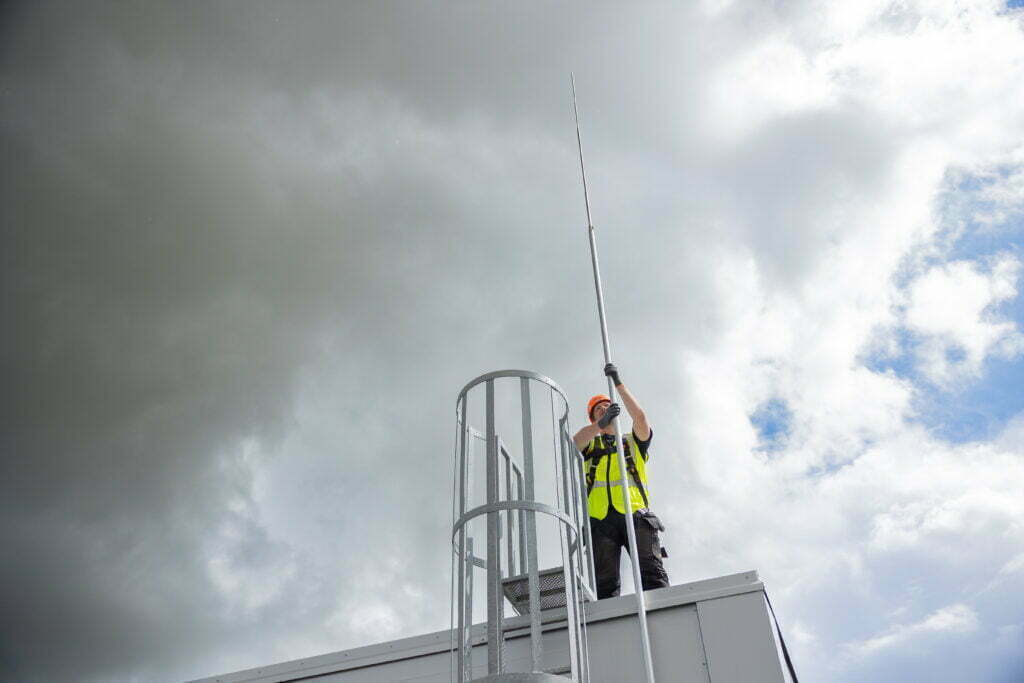
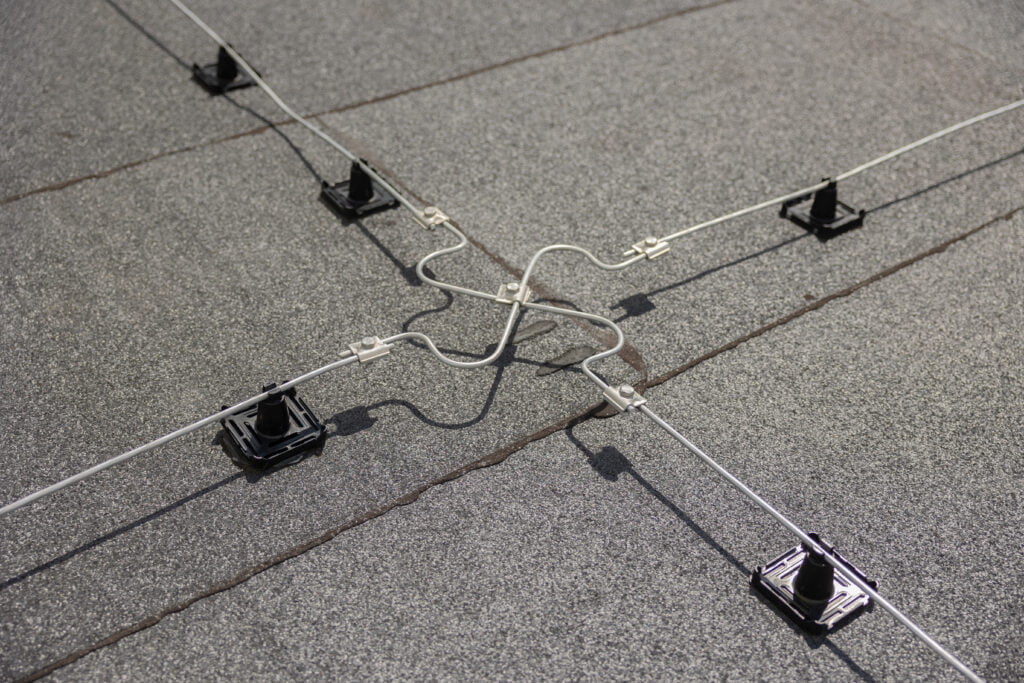
A building structure can rarely withstand being struck by a direct lightning strike. One of the main elements of a lightning protection system is therefore the air-termination system, which must ensure that the building is struck in a controlled manner and that no damage occurs to the building itself. The air-termination system consists of a combination of mesh conductors and air-termination masts of varying heights. Often, large roof surfaces can be protected solely by a mesh conductor system, but where other objects are installed on the roof that must not be struck by lightning, it is necessary to supplement with shorter or taller air-termination masts.
An air-termination system is designed and constructed to withstand the direct dynamic and thermal effects of lightning. This places specific requirements on the placement of the system on the building’s roof, as well as on the selection and dimensioning of the correct components and materials.
Internal lightning protection
Once the exterior of the building is protected against the direct effects of a lightning strike, the next step is to ensure that indirect effects cannot impact the building’s internal installations and systems.
The internal protective measures are carried out in accordance with DS/EN 62305-4, which describes the measures required to ensure that magnetic fields and transients cannot propagate into the building.
Internal lightning protection typically consists of the following protective measures:
- Zone division
- Equipotential bonding
- Transient protection
- Shielding
Zone division
Not all areas or systems within a building are equally sensitive to the indirect effects of lightning – and the building can therefore advantageously be divided into zones where additional measures are taken to protect equipment and installations. These will often include technical rooms, control rooms, laboratories, server rooms, ATEX areas, etc., which must be protected to a high level in order to avoid damage and operational downtime. All installations entering or leaving such a zone must be bonded either through equipotential bonding or transient protection. In many cases, it is also beneficial to incorporate additional shielding in the floors, ceilings, and walls of the zone.
Equipotential bonding
As a supplement to the legally required equipotential bonding that is carried out in every electrical installation, additional lightning equipotential bonding must be performed for, among others, the following system components:
- Reinforcement in cast concrete structures for columns, shafts, walls, and floor slabs
- Elevator equipment (can advantageously be bonded to the reinforcement in the elevator shaft)
- Ventilation systems
- Cable routing systems
- Piping systems for sprinklers, water, heating, gas, etc.
- Conductive façade systems
It is important that all these continuous installations and building components are bonded at a minimum at the top and bottom of the building, but it will often also be necessary to carry out bonding on individual floors and at entry points to lightning protection zones.
Transient protection
All cable systems in a building will be susceptible to induced magnetic fields from lightning currents in the external lightning protection system. It is therefore very important that transient protection is installed at multiple points in the system – and not only in main distribution boards for electrical power or fuse and building automation systems.
Transient protection is also referred to as surge protection, as it ensures that transient overvoltages on power or signal ports of electrical equipment do not exceed what the equipment is designed to withstand. All equipment that is CE-marked in accordance with the EMC Directive is tested for a maximum overvoltage (surge) – and it can therefore be beneficial to be aware of this level.
Surge protective devices must be installed in all sub-distribution boards for power supply, fuse systems, or building automation, and also where these installations enter dedicated lightning protection zones. Here too, Electricon has the necessary knowledge and expertise to advise our customers. We are also happy to deliver complete specification and/or material packages to the responsible panel builders.
Shielding
This largely concerns shielding installations and equipment against harmful magnetic fields that arise when high lightning currents flow through the building’s lightning protection system. There are several methods for implementing such shielding to attenuate magnetic fields, and this can be done in both building structures and installations.
The most common form of shielding is the use of shielded cables for all sensitive installations. It is important that these shielded cables are selected so that they are effective against the frequencies represented by magnetic fields from lightning (typically from approx. 25 kHz to 1–2 MHz). It is also essential that the cable shield is capable of carrying the induced current that will flow in the shield. To ensure effective shielding, shielded cables must always be terminated and bonded at both ends – and often also at intermediate points if the shielded cable crosses a lightning protection zone boundary.
Within the lightning protection zone itself, it may be necessary to install room shielding in walls, floors, and ceilings – and this is often easier than expected. Room shielding can be implemented using the concrete reinforcement that is often already present, and there are simple rules in the standard that must be followed in order for the zone to be effectively shielded. In cases where reinforced concrete is not present, shielding can be established using metal mesh or plates that are connected to the local equipotential bonding within the zone.
We are ready to help

A glimpse into our everyday life at Electricon

What our customers say

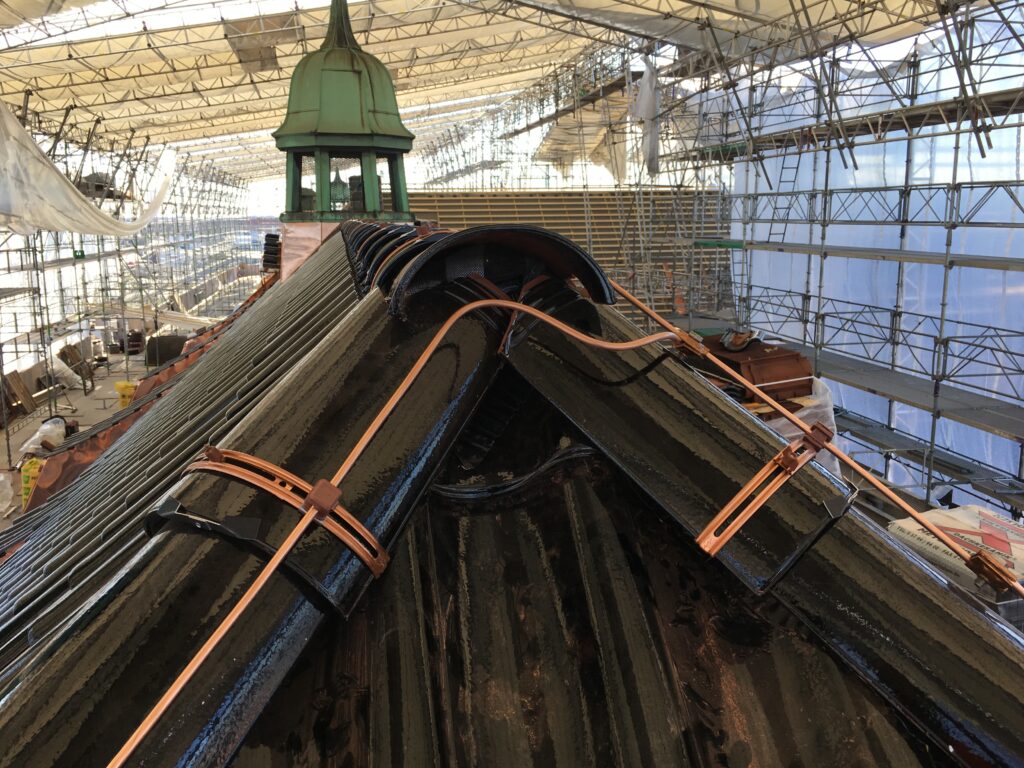
"Electricon carried out repairs on the existing lightning protection system at Gråsten Castle. The project was completed with Electricon serving as the main contractor...."

"Bravida can give Electricon A/S the highest recommendations for both quality and safety...."

"M. J. Eriksson A/S has been extremely satisfied with the service provided by Electricon. With an incredibly solution-oriented approach, everything has been delivered on time and within budget...."

"Electricon has been professional, adaptable, and service-minded throughout the entire process...."

"Electricon is a pleasure to work with. They are flexible and adaptable, always willing to adjust in order to achieve a common goal...."